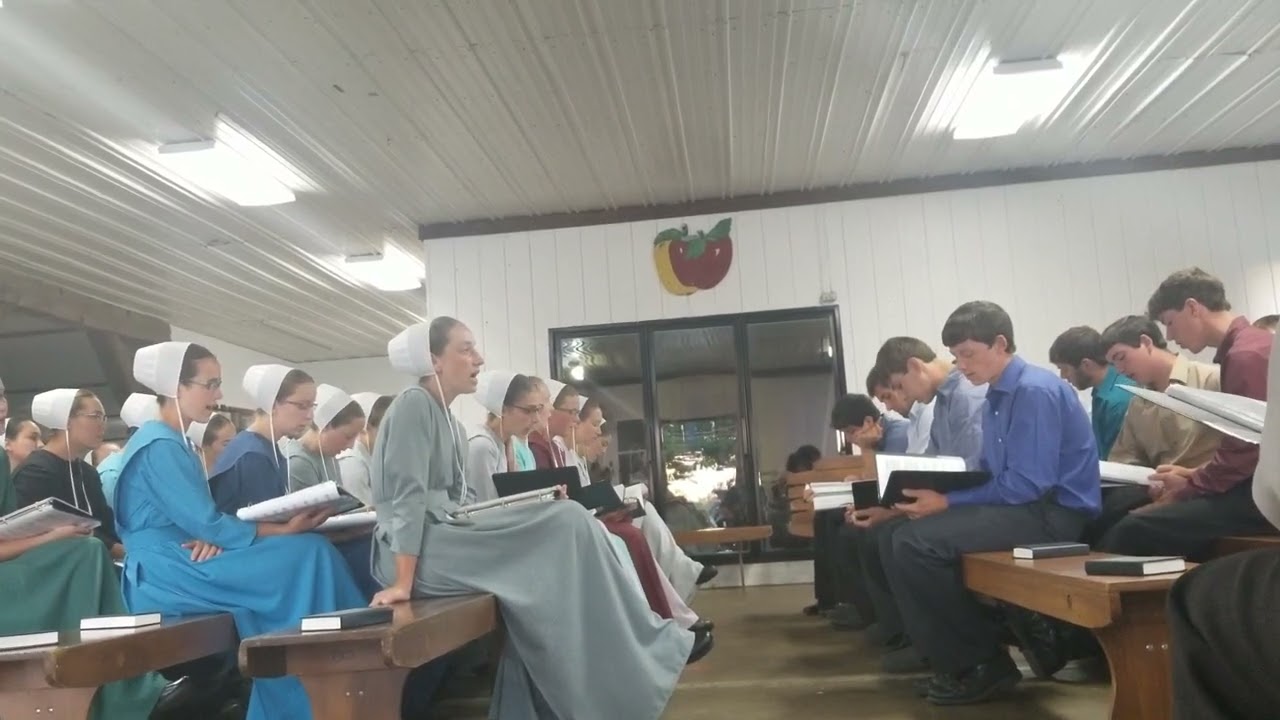
Recently I came across a video of Amish youth singing How Deep the Father’s Love for Us a cappella. As I listened, I found myself unexpectedly moved to tears. It was not because the singers were Amish, nor because I had suddenly become convinced that all church music should be unaccompanied. Rather, the video awakened a profound sense of loss.
I grew up hearing and singing songs like this in church and at summer Bible camps. There was nothing unusual about a room full of Christians lifting their voices together in song. The congregation was not listening to worship. The congregation was creating it. Worship was something we did together. The voices of ordinary believers filled the room, blending into a single offering of praise.
Somewhere along the way, that experience disappeared from many of the churches I knew. Today, in most places I’ve been, worship is led by skilled musicians on a stage, amplified through speakers, and carefully curated through lighting and other effects. Of course, many people in the congregation still sing, but you can rarely hear them. The dominant sound comes from the platform. Though hundreds of people may be present, the experience often feels strangely individual, as if each person is worshiping privately while standing in a crowd.
Watching this video reminded me of something I had not realized I missed so deeply: the sound of God’s people singing together. There is a fullness to congregational singing that cannot be replicated by amplification or performance. When many voices join together, something beautiful happens. The elderly and the young, the good singers and the poor singers, all contribute to the same act of worship. It is a human, communal act.
I was reminded of this last year during a trip to M. Camp. A thunderstorm rolled through during an evening service and knocked out the power. Without microphones, instruments, or a sound system, the congregation began singing hymns together. One song led to another: Amazing Grace, How Great Thou Art, and many more. The experience was spontaneous, yet it felt completely natural.
The tabernacle seemed to come alive. The sound of singing filled the building as voices echoed from every direction. The praise felt larger than any individual contribution. No one was performing. No one was leading from a platform. We were simply singing together, and everyone participated.
People talked about that service for days afterward. They posted videos online and spoke about how moving it had been. Yet as I reflected on the experience, one question kept returning to my mind: Why does a power outage have to occur in order to have this experience?
It made me wonder about some of the changes I saw happening in the churches I grew up in. In the evangelical settings I was part of, there was often a pressure to innovate, adapt, and remain relevant. Practices inherited from previous generations were sometimes replaced by newer methods that promised greater effectiveness or broader appeal. Even churches that offered a “traditional service” frequently preserved little more than the hymns themselves. Many of the older patterns of worship and congregational life quietly faded away.
As an Orthodox Christian, I am grateful for where my journey ultimately led, and I have no desire to return to evangelicalism. I believe I found the home for which I had been searching. Nevertheless, moments like this still fill me with a measure of sadness. If the churches I knew had shown greater concern for preserving what they inherited, if continuity had been valued alongside innovation, I sometimes wonder how my journey might have unfolded.
When I watched those Amish youth sing, I was not simply enjoying a beautiful hymn. I was hearing an echo of something I once knew — a glimpse of a world that has faded as churches responded to changing culture and technology.

Leave a Reply