Write description here.
Author: Milton McDonald
-

Fasting of the Eyes
From Death to the World
Fasting of the Eyes argues that modern people are constantly inundated with images through social media, news, entertainment, and advertising, and that this endless stream of visual content has profound spiritual consequences. The author, Metropolitan Saba (Esper), contends that images shape the imagination, influence thoughts, and can feed unhealthy passions and temptations.
More…
The article calls Christians to practice a kind of fasting of the eyes by intentionally limiting what they look at and consume. Just as traditional fasting disciplines the body, guarding the eyes disciplines the mind and heart. The goal is not merely avoiding inappropriate content, but cultivating purity, attentiveness to God, and freedom from the addictive pull of modern media.
In essence, the article warns that unchecked visual consumption can become a form of spiritual slavery and encourages believers to be deliberate about what they allow into their minds through their eyes.
-
[I Feel Like] She’s Leaving Me
Joe Le-Mon preached the most profound message I ever heard during my years in the youth tabernacle at summer C&MA camp. His sermon centered on Christ as the eternal Tao, the true Way who gives order, life, and meaning to the universe. Drawing on Plato’s Republic, he spoke of the Just Man who would be rejected, humiliated, and executed as a criminal, and then showed how that vision finds its fulfillment in Jesus Christ. For the first time, I heard a preacher place Christ at the center of everything, not as one topic among many, but as the very foundation of reality itself.
Read More
At that point, I was no longer a student. I was a youth leader. Yet Joe articulated with clarity what I had been trying to communicate to my students for years. Christ is not merely someone we acknowledge on Sundays. He is not a means to a comfortable life or a ticket to heaven secured by a single prayer. He is the source and purpose of existence itself. To turn away from Him is not simply to break a rule; it is to cut oneself off from the very fountain of life.
What distinguished Joe even more was his refusal to preach the therapeutic, self-centered message so common in modern youth ministry. He did not tell us to find our identity, pursue our dreams, or rest content in who we already were. Instead, he preached self-denial, obedience to Christ, repentance, the corruption and complacency of the modern church, and the need to recover what has been lost. His message carried the weight of conviction and the ring of truth.
That same spirit permeated his music. His album The Lament became a companion to me during my journey into the Orthodox Church. I listened to it hundreds of times. It gave voice to questions I had carried for years and reassured me that I was not alone in seeing the fractures within contemporary Christianity or in longing for something deeper, older, and more faithful. Its songs expressed both grief and hope, lament and longing, in a way few artists ever have.
I would encourage anyone to listen to the album in its entirety. One song in particular, [I Feel Like] She’s Leaving Me, remains especially meaningful to me.
Joe, if you happen to read this, thank you. Your preaching and music did more than inspire me. They helped give language to a spiritual hunger that had been growing in my heart for years, and they pointed me more deeply toward Christ, the eternal Way. For that, I will always be grateful.
-

The Religion of the Apostles: Orthodox Christianity in the First Century
Father Dr. Stephen De Young traces the lineage of Orthodox Christianity back to the faith and witness of the apostles, which was rooted in a first-century Jewish worldview. The Religion of the Apostles presents the Orthodox Christian Church of today as a continuation of the religious life of the apostles, which in turn was a continuation of the life of the people of God since the beginning of creation.
Read More
One of the common claims I encountered during my journey was that many distinctive Orthodox practices, such as the veneration of icons, prayers to the saints, and the priesthood, were later corruptions introduced centuries after the apostolic age, often with Constantine cast as the chief culprit. I appreciated this book because it challenged that narrative by tracing these practices back through the life of the early Church and the first-century world of the apostles. Rather than presenting Orthodoxy as a collection of later additions, Fr. Stephen shows how many of its beliefs and practices emerged organically from the faith the apostles already lived, transformed and fulfilled through the Incarnation, death, and resurrection of Christ.
While I do not agree with every argument in the book, and at times I felt the author stretched the evidence further than necessary, I found it immensely valuable. More than anything, it helped me understand that Orthodox Christianity stands on a deep historical and theological foundation. Even when I remained unconvinced by a particular point, I could no longer dismiss Orthodox beliefs as arbitrary innovations or medieval inventions. The book gave me a new appreciation for the continuity between the ancient people of God, the apostles, and the Orthodox Church today.
-
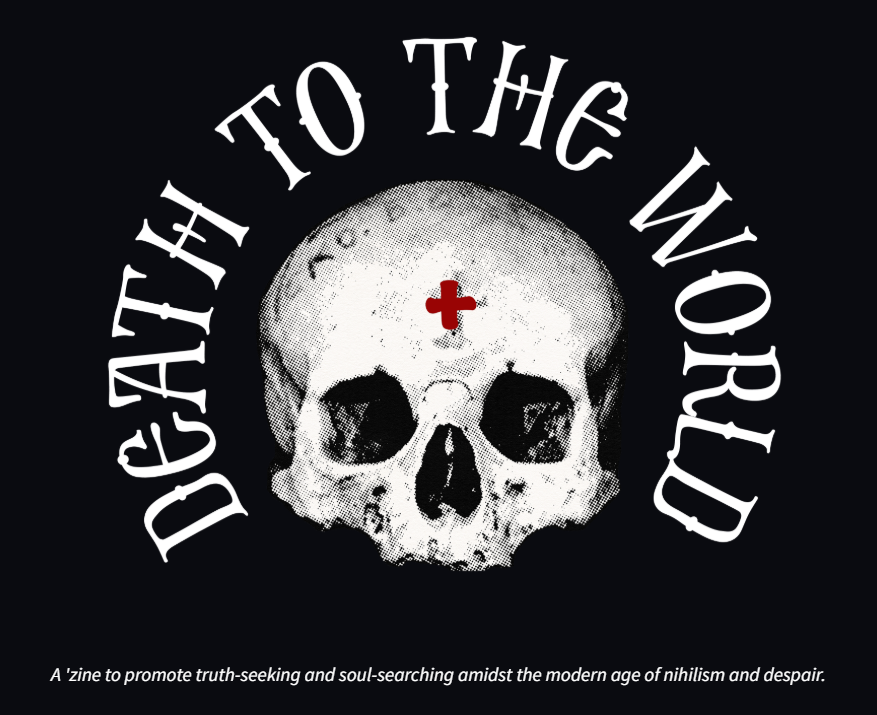
Death to the World
This is the ‘zine that started it all! My journey began by accidentally stumbling onto Death to the World, a ‘zine promoting the ancient principles of the last true rebellion: to be dead to this world and alive to the other world.
(more…) -
Open to Me the Doors of Repentance
Open to Me the Doors of Repentance is one of the most beloved hymns of the Orthodox liturgical year. Sung during the preparatory weeks before Great Lent, it is a heartfelt prayer in which the believer asks God to open the way to repentance, acknowledging his sinfulness while longing for mercy and spiritual renewal. Rather than focusing on guilt alone, the hymn expresses hope that God will receive those who turn to Him with humility and sincerity.
Read More
Through its simple yet powerful words, the hymn captures the spirit of the Lenten journey: self-examination, repentance, and the desire to draw nearer to Christ. Its solemn melody and deeply personal message have made it one of the most cherished hymns in Orthodox worship, serving as an invitation to begin the struggle of repentance with honesty, humility, and trust in God’s mercy.
-

Orthodoxy and Heterodoxy
Discover how Orthodox Christianity and non-Orthodox doctrine differ and why it matters to your spiritual journey. (This updated version was recorded 2015-2016.) A fuller treatment of these topics, with material not included in the podcast, is found in the book by the same name.
Read More
This podcast taught me more about the history and development of my own evangelical tradition than I had learned in all my previous years as a Christian. I was surprised to discover how recent some movements are, including Pentecostalism, and I found myself wrestling with questions I had never previously considered. As I learned more about church history, I became increasingly aware of how much of the historic Christian tradition my own background had set aside. I was also struck by the fact that many groups claiming to follow the Bible alone could arrive at radically different conclusions about doctrine and practice. While I recognized important differences between evangelical Christianity, Mormonism, Jehovah’s Witnesses, and other movements, I could no longer dismiss the question of how Christians determine which interpretations are correct once the authority of historic tradition is removed. The podcast challenged assumptions I had long taken for granted and pushed me to think more seriously about authority, continuity, and the relationship between Scripture and the Church.
-
Let My Prayer Arise
Let My Prayer Arise is a recording of the hauntingly beautiful Lenten hymn sung during the Liturgy of the Presanctified Gifts in the Orthodox Church. Drawn from Psalm 141, the hymn expresses the believer’s longing that his prayers rise before God like incense. For many Orthodox Christians, it is one of the most moving musical moments of Great Lent, capturing the penitential and prayerful character of the season.
Read More
I will never forget experiencing this hymn during Great Lent while prostrate on the floor for its entirety. It was one of the most profound moments of worship I had ever experienced. The combination of the chant, the prayers, the incense, and the physical posture of humility before God communicated a reverence that I had never encountered elsewhere. In my experience, no other Christian tradition places such visible emphasis on awe, repentance, and reverence before God within the actual corporate worship of the congregation. Rather than merely speaking about humility before God, the service invited me to embody it.
-

Youth of the Apocalypse and the Last True Rebellion
This manifesto for the despairing children of the eleventh hour deals with the issues that are tearing apart the fabric of innocence: depression, anxiety, suicide, addiction, violence, and the broken home. The author takes the reader through a tour of the wasteland of modern life, offering a painfully honest appraisal of modern society, and ends with a path to healing and purpose. Released in 2024 on the 30th anniversary of the first edition, this new, updated second edition includes commentary on modern cyber, tech and media issues facing the youth of today.
Read More
This book hit me hard as a youth leader because I was watching many of my own students struggle with the very issues it describes. I saw anxiety, depression, broken families, hopelessness, and various forms of self-destructive behavior, yet I often felt powerless to help in any lasting way. Despite all the programs, retreats, Bible studies, and good intentions, I could not escape the feeling that we lacked a coherent spiritual path capable of bringing real healing and transformation. The questions this book raised became a catalyst for my own search, eventually launching a much deeper exploration of Orthodoxy and its understanding of the spiritual life.
-
Pascha Across America (2026)
This video highlights Holy Week and Pascha celebrations from Orthodox churches across the United States. I appreciate it because it demonstrates the unity of the Orthodox faith, which remains the same in every parish. It is the faith that has been shared by Orthodox Christians everywhere and throughout the ages.